
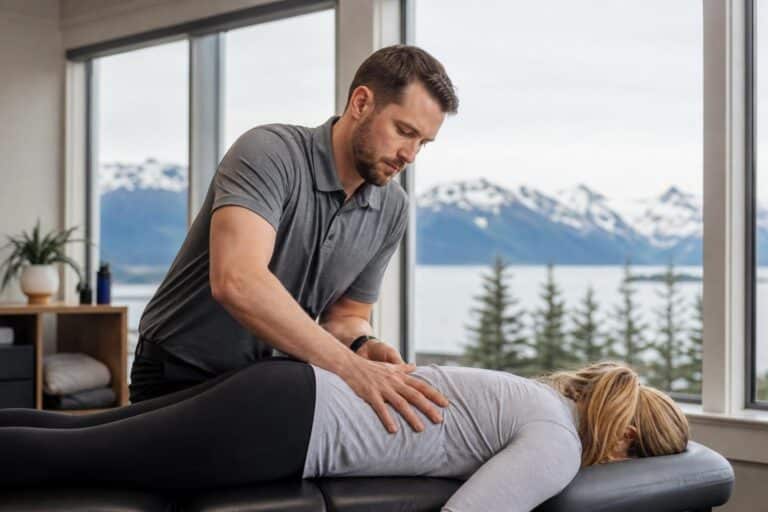
Alaska’s chiropractic market is unlike any other state. Geographic isolation, a small population spread across a massive landmass, and fierce competition for healthcare talent all make finding the right associate DC a real challenge. If you’re a practice owner ready to grow, here’s everything you need to know about hiring an associate chiropractor in Alaska, from compensation and licensing to sourcing and onboarding.
Hiring an Associate DC in Alaska: Key Facts
Associate chiropractor salaries in Alaska typically range from $90,000 to $105,000 per year. The Alaska Board of Chiropractic Examiners handles all DC licensing in the state. Non-compete agreements are enforceable if they’re reasonable in time, geography, and scope, but you should confirm specifics with Alaska counsel. Expect the full hiring process to take 60 to 120 days from job posting to a signed contract. With roughly five open positions for every available associate nationally, the candidate market favors job seekers, not employers.
The Associate Hiring Landscape in Alaska
You already know Alaska isn’t like practicing in the Lower 48. Your candidate pool is smaller, relocation is a bigger ask, and the cost of living in cities like Anchorage, Fairbanks, or Juneau adds another layer to your compensation planning. Most DCs graduating from chiropractic colleges aren’t thinking about Alaska first. That means you’re competing not just with other Alaska practices but with warmer, more accessible markets across the country.
The reality is that most practice owners underestimate how long it takes to find a qualified associate. If you wait until you’re drowning in patients and can’t take a day off, you’ve already waited too long. Smart owners start recruiting three to six months before they actually need someone on the floor. That buffer gives you time to screen properly, negotiate terms, and handle the licensing timeline without rushing into a bad fit.
Alaska’s geographic spread also means your associate might need to serve patients across a wide area. Defining the role clearly before you post a single job ad will save you headaches later. Are you hiring a caregiver to handle your overflow, or a business builder who’ll help grow new patient volume? Your answer shapes everything from the compensation model to the interview questions you ask.
What Does an Associate Chiropractor Cost in Alaska?
Base salaries for associate DCs in Alaska fall between $90,000 and $105,000 annually. That’s above the national average, which hovers closer to $85,000 to $95,000 in most markets. The premium reflects Alaska’s higher cost of living and the difficulty of recruiting talent to the state.
But the base number is only part of the picture. Many Alaska practices use a hybrid compensation model: a guaranteed base salary plus a percentage of collections once the associate hits a production threshold. This structure aligns incentives. Your associate earns more as they contribute more, and you aren’t stuck paying top dollar before they’ve built a patient base.
Signing bonuses are increasingly common, especially for candidates willing to relocate. Expect to offer $5,000 to $15,000 depending on the candidate’s experience and how remote your location is. Relocation assistance, whether a lump sum or reimbursement, can tip the scales in your favor when you’re asking someone to move thousands of miles.
Don’t overlook benefits either. Health insurance, continuing education stipends, paid time off, and retirement contributions all factor into a candidate’s decision. A great associate should deliver roughly a 3X return on their total compensation. If your pay structure is outdated or below market, you’ll struggle to attract serious candidates, let alone keep them.
Licensing Requirements for Associate DCs in Alaska
Every chiropractor practicing in Alaska must hold an active license issued by the Alaska Board of Chiropractic Examiners. There are no shortcuts here, and the process takes time, so factor it into your hiring timeline.
Candidates need to have graduated from a Council on Chiropractic Education (CCE) accredited program. They must pass all parts of the National Board of Chiropractic Examiners (NBCE) exams, including Parts I through IV and the Physiotherapy exam. Alaska also requires applicants to pass a jurisprudence examination covering the state’s specific chiropractic statutes and regulations.
For out-of-state DCs, Alaska does allow licensure by credentials. This means a chiropractor already licensed and practicing in another state can apply without retaking the full battery of exams, provided they meet the board’s requirements. The application still requires verification of education, exam scores, and a clean disciplinary record. Processing times vary, but plan for four to eight weeks from submission to approval, assuming the application is complete.
You can find the full application requirements, fee schedule, and current forms on the board’s official page at https://www.commerce.alaska.gov/web/cbpl/professionallicensing/boardofchiropracticexaminers.aspx. Rules change periodically, so always verify current requirements directly with the board before making assumptions about a candidate’s eligibility.
One practical tip: start the licensing conversation early in the interview process. If your top candidate is coming from out of state, knowing their exam history and current license status helps you estimate when they can actually start seeing patients. A six-week licensing delay can throw off your entire onboarding plan if you haven’t accounted for it.
Employment Law & Non-Competes for Chiropractors in Alaska
Non-compete clauses in Alaska are enforceable, but only if they’re reasonable. Courts evaluate three factors: the duration of the restriction, the geographic scope, and how narrowly the activity limitation is defined. A two-year, 15-mile non-compete in Anchorage will be viewed very differently than the same terms in a rural community where you’re the only chiropractor within 100 miles.
Alaska doesn’t have a specific statute governing non-competes for chiropractors. Instead, chiropractic associates fall under the state’s general non-compete standards. Courts will toss out agreements they consider overly broad or punitive. Your best protection is a well-drafted agreement reviewed by an Alaska attorney who understands both employment law and the healthcare sector.
Beyond non-competes, classification matters. If you’re bringing on an associate as a W-2 employee, you’ll handle payroll taxes, benefits, and workers’ compensation. If you’re considering an independent contractor arrangement, be very careful. The IRS and Alaska’s Department of Labor look at the actual working relationship, not just what the contract says. If you control when, where, and how the associate works, they’re likely an employee regardless of the label.
A solid associate agreement should cover compensation structure, performance expectations, termination provisions, non-compete and non-solicitation terms, malpractice insurance responsibilities, and a clear dispute resolution process. Don’t use a template you found online. Invest in a contract drafted or reviewed by legal counsel familiar with Alaska’s employment laws.
This section is general information, not legal advice. Always confirm specifics with a qualified Alaska attorney before finalizing any employment agreement.
Where to Find Associate Chiropractor Candidates in Alaska
Sourcing candidates in Alaska requires more creativity than posting on Indeed and waiting. The state has no chiropractic college, so you’re pulling from out-of-state programs. The two closest options are Life Chiropractic College West in Hayward, California, and the University of Western States in Portland, Oregon. Building relationships with career services departments at these schools can put your practice on graduating students’ radar before they commit to other opportunities.
The Alaska Chiropractic Society is another useful channel. State association job boards and newsletters reach DCs who already have a connection to Alaska or are actively considering the market. National platforms like ChiroHealthUSA’s job board, DynamicChiropractic.com, and general healthcare job sites can widen your reach, though you’ll sort through more unqualified applicants.
Referral networks remain one of the most effective sourcing tools. Ask colleagues, mentors, and even your current patients if they know a DC looking for an opportunity. Word-of-mouth candidates tend to be better vetted informally before they ever reach your inbox.
Here’s the honest truth about DIY recruiting: it’s time-consuming. Most practice owners spend 15 to 25 hours per hire on sourcing, screening, and interviewing, and that’s if things go smoothly. Low response rates on job postings, no-shows for interviews, and candidates who ghost after initial conversations are all common. If your time is better spent treating patients and running your practice, a specialized recruiting partner like Chiro Match Makers can handle the sourcing, vetting, and initial interviews for you. Their team has placed hundreds of associates and understands the unique challenges of hiring in markets like Alaska.
How to Hire an Associate Chiropractor in Alaska, Step by Step
Start by defining the role. Are you hiring someone to take over existing patients so you can step back, or do you need a producer who’ll build their own caseload? This distinction drives your compensation model, your interview questions, and the type of candidate you target.
Next, set your compensation package. Use the $90,000 to $105,000 range as your baseline and decide whether you’ll include production bonuses, signing incentives, or relocation support. Put the full package in writing before you start recruiting. Candidates want clarity, not vague promises.
Write a compelling job posting that highlights what makes your practice and location attractive. Alaska’s outdoor lifestyle, tight-knit communities, and unique patient demographics are genuine selling points for the right candidate. Be specific about technique expectations, patient volume, and growth opportunities.
Screen applicants with a phone or video interview first. You’re checking for communication skills, alignment with your practice philosophy, and genuine interest in Alaska. Don’t skip this step. It saves you from wasting time on in-person interviews with candidates who aren’t serious.
For your top two or three candidates, conduct in-person or extended video interviews. Use behavioral questions: ask about past experiences managing patient relationships, handling difficult cases, and working within a team. Chiro Match Makers recommends behavioral assessments to match candidates with your practice culture, which can reveal fit issues that interviews alone miss.
Once you’ve identified your top pick, extend a written offer with a clear response deadline. Include all compensation details, start date, and contingencies like background checks and license verification. After the offer is accepted, begin the onboarding process: licensing paperwork, malpractice insurance setup, EHR training, and introductions to your team and patients.
Send polite rejection letters to other candidates, but keep your second choice warm in case the deal falls through.
Hiring an Associate Chiropractor in Alaska: FAQ
How much does an associate chiropractor cost in Alaska?
Base salaries typically range from $90,000 to $105,000 per year. Total compensation, including bonuses, benefits, and relocation assistance, can push the number higher. Production-based models can increase earnings for high-performing associates while protecting your bottom line.
How long does it take to hire an associate DC in Alaska?
Plan for 60 to 120 days from posting the position to having someone start. Licensing for out-of-state candidates can add four to eight weeks. Starting the process early gives you the best chance of finding a strong match without rushing.
Are non-competes enforceable for chiropractors in Alaska?
Yes, but only if the terms are reasonable in time, geography, and scope. Courts will strike down overly broad restrictions. Have an Alaska attorney draft or review your non-compete clause to ensure it holds up.
Should I offer a base salary or production-only pay?
A base salary attracts more candidates and provides financial security during the ramp-up period. Production-only arrangements are legal but less appealing to most associates, especially those relocating. A hybrid model with a base plus production bonuses tends to work best for both parties.
Can I hire a chiropractor licensed in another state?
Yes. Alaska offers licensure by credentials for DCs already licensed elsewhere. The candidate still needs to meet the Board of Chiropractic Examiners’ requirements, including the jurisprudence exam. Start the application process as soon as possible to avoid delays.
What if I don’t have time to recruit on my own?
Most practice owners don’t. Between patient care, staff management, and business operations, recruiting often falls to the bottom of the list. That’s exactly why firms like Chiro Match Makers exist. They handle sourcing, vetting, and initial interviews so you can focus on your practice. As one practice owner, Sabrina Gya, put it about working with their team: “My current VA is probably the best team member I have had in the last 25yrs of being a business owner.”
Hire Your Next Associate in Alaska With Chiro Match Makers
Finding the right associate DC in Alaska takes time, strategy, and a deep understanding of the chiropractic job market. Chiro Match Makers specializes in exactly this. Their team sources, screens, and matches candidates to your practice culture so you’re not sifting through unqualified resumes or wasting weeks on dead-end interviews. If you’re ready to grow your practice with the right person, schedule a complimentary call with one of their DC Placement Specialists.
And if you’re also looking for front desk or administrative support, consider their virtual chiropractic assistant service. Real people, genuinely affordable, starting at $9.87 per hour. Get started here.
Sources
Salary data referenced in this article is informed by the U.S. Bureau of Labor Statistics Occupational Outlook for Chiropractors and adjusted for Alaska’s market conditions. Licensing requirements and application procedures are based on information from the Alaska Board of Chiropractic Examiners, accessible at https://www.commerce.alaska.gov/web/cbpl/professionallicensing/boardofchiropracticexaminers.aspx. The Alaska Chiropractic Society provides additional resources for practicing DCs and practice owners in the state. Hiring process insights and compensation benchmarks are drawn from Chiro Match Makers’ experience placing hundreds of associate DCs across the United States. Always verify current regulations and legal requirements with the appropriate state board or a qualified attorney.